Agapanthus, commonly called lily of the Nile, delivers bold, globe-shaped blooms on tall stalks with minimal fuss, making it a go-to choice for front yard landscaping that needs to look good from the curb and survive less-than-perfect care. These perennials thrive in USDA zones 8–11, tolerate drought once established, and come back year after year with clusters of blue, white, or purple flowers that peak in summer. For homeowners tired of high-maintenance annuals or patchy lawn edges, agapanthus offers structure, color, and a low-water footprint. This guide covers variety selection, design strategies, and the practical planting steps that keep these plants looking sharp season after season.
Table of Contents
ToggleKey Takeaways
- Front yard landscaping with agapanthus offers drought-tolerant, low-maintenance perennials that thrive in USDA zones 8–11 and require minimal supplemental watering once established.
- Agapanthus varieties range from dwarf ‘Peter Pan’ at 12–18 inches to full-size praecox species at 36–48 inches, allowing you to match plant height to your space and design goals.
- Proper soil drainage is essential for agapanthus success; amend heavy clay with compost or perlite, keep the crown level with soil when planting, and maintain 2–3 inches of mulch away from the base.
- Design agapanthus in mass plantings of odd-numbered groups, as border plantings along walkways, or as focal points near entries and mailboxes, paired with contrasting foliage plants for visual impact.
- Establish new agapanthus plants by watering weekly for 8–12 weeks, then reduce frequency to every 10–14 days; apply balanced fertilizer in spring and divide crowded clumps every 4–6 years to maintain strong blooming.
Why Agapanthus Are Perfect for Front Yard Landscaping
Agapanthus checks multiple boxes for front yard success. First, they’re drought-tolerant once the root system establishes, typically after the first growing season. That means less supplemental watering compared to thirsty perennials like hydrangeas. In regions with water restrictions or clay soil that drains poorly, this resilience matters.
Second, the upright growth habit creates vertical interest without blocking sightlines. Mature plants reach 18 to 48 inches tall depending on variety, with strap-like foliage forming dense clumps at the base. The flower stalks rise above the leaves in late spring through summer, giving a layered look that works along walkways or in front of foundation plantings.
Third, agapanthus are low-maintenance. They don’t require deadheading to keep blooming (though removing spent flower heads improves appearance), resist most pests, and spread slowly enough that they won’t overrun adjacent plants. Deer and rabbits typically leave them alone due to mildly toxic sap.
Finally, they’re versatile in design. Agapanthus pairs well with ornamental grasses, lavender, salvia, and Mediterranean-style plantings. The blooms attract pollinators, primarily bees and butterflies, adding movement and ecological value to the front yard. They also work in containers flanking an entryway, provided the pots are at least 12 inches in diameter to accommodate the fleshy root mass.
Best Agapanthus Varieties for Front Yard Designs
Choosing the right variety depends on climate zone, available space, and color preference. Here are proven performers:
Agapanthus ‘Peter Pan’ is a dwarf cultivar that tops out at 12 to 18 inches, making it ideal for tight spaces along walkways or in container groupings. It produces blue flowers and works in zones 8–11. Use it where taller varieties would obstruct views or overwhelm smaller front yards.
Agapanthus ‘Storm Cloud’ offers deep violet-blue blooms on 24- to 30-inch stalks. The flower color is richer than most blue varieties, creating strong contrast against light-colored siding or gravel mulch. It’s evergreen in mild climates and deciduous where winters dip below 20°F.
Agapanthus ‘Queen Mum’ is a bicolor selection with white petals edged in blue. It reaches 24 to 36 inches and adds visual complexity without requiring additional plant species. Effective as a focal point near mailboxes or at pathway intersections.
Agapanthus praecox (common agapanthus) is the workhorse species, widely available and reliably hardy in zones 8–10. It grows 36 to 48 inches tall with blue or white flower heads up to 8 inches across. This variety naturalizes well and tolerates a range of soil types, from sandy loam to heavier clay (as long as drainage is adequate).
Agapanthus ‘Twister’ features variegated foliage, green leaves striped with creamy white, adding year-round interest even when not in bloom. It grows 18 to 24 inches tall and works well in mixed borders where foliage texture matters as much as flowers.
For cold-hardiness, deciduous hybrids like the Headbourne series can survive zone 6 winters with mulch protection. Evergreen varieties are better suited to zones 9–11 and won’t tolerate prolonged freezes.
Design Ideas: How to Use Agapanthus in Your Front Yard
Border and Edging Plantings
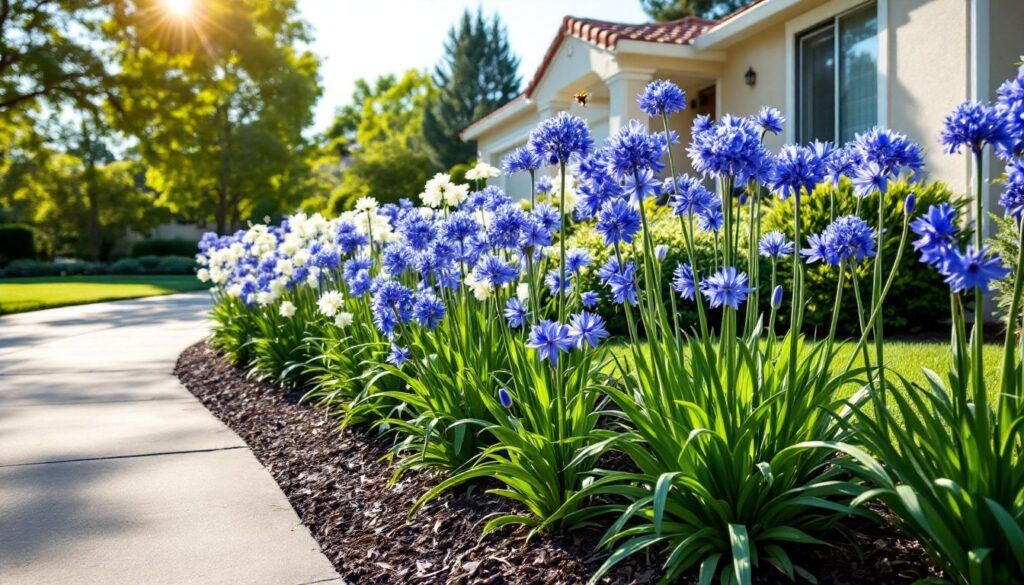
Agapanthus excels as a border plant along driveways, walkways, or property lines. Space plants 12 to 18 inches apart (measuring from center to center) to allow for mature clump spread without crowding. This spacing creates a continuous ribbon of foliage with overlapping bloom coverage in summer.
Pair agapanthus with low groundcovers like creeping thyme or silver carpet (Dymondia margaretae) at the front edge to soften hardscape transitions. Behind the agapanthus, use taller plants such as fountain grass (Pennisetum setaceum) or society garlic (Tulbaghia violacea) to build layered depth. Avoid planting agapanthus directly against foundations where reflected heat and limited root space can stress plants.
For a formal edge, select a single variety and maintain uniform spacing. For a cottage-garden look, mix two or three varieties with staggered bloom times, early-season ‘Storm Cloud’ followed by mid-summer ‘Peter Pan’, to extend color from May through August.
Mass Plantings and Focal Points
Mass plantings create bold impact, especially on larger lots or along sweeping curves. Plant clusters of 5 to 9 agapanthus in irregular groups (odd numbers look more natural than even), spacing them 18 to 24 inches apart. This approach works well in front of fences, retaining walls, or as an understory beneath high-canopy trees like birch or Japanese maple.
Use agapanthus as a focal point by planting a single large clump (3 to 5 plants tight together) at a visual anchor, next to a mailbox, flanking entry steps, or in a courtyard bed. Surround the focal clump with contrasting foliage plants: gray-leafed lamb’s ear (Stachys byzantina), chartreuse creeping Jenny (Lysimachia nummularia ‘Aurea’), or dark mondo grass (Ophiopogon planiscapus ‘Nigrescens’).
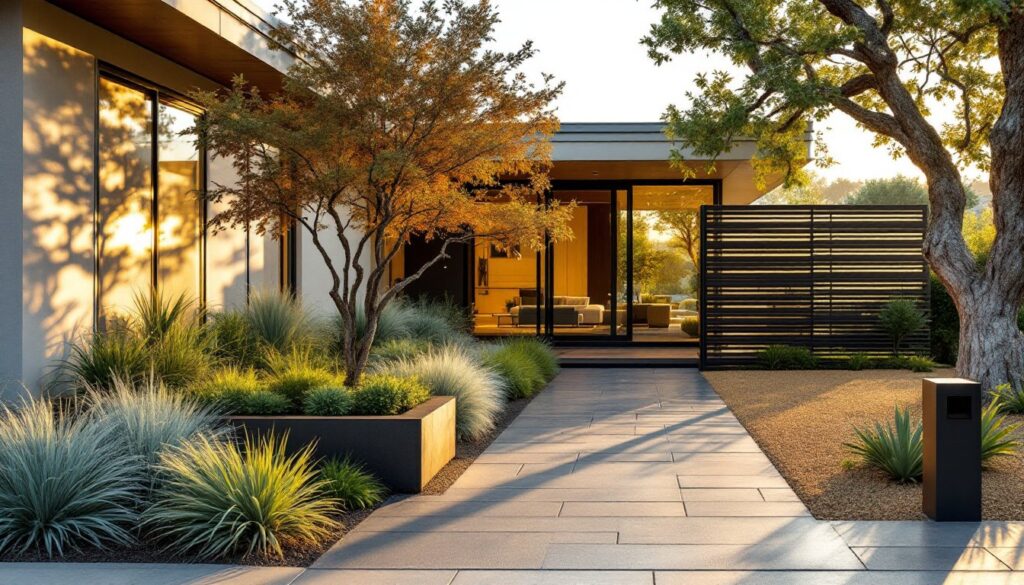
In contemporary designs, pair agapanthus with geometric hardscaping, square pavers, linear concrete edging, or steel planters, to emphasize the plant’s structural form. In Mediterranean or coastal styles, combine them with lavender, rosemary, and succulents in a gravel or decomposed granite bed for a low-water, high-texture palette.
Planting and Care Tips for Thriving Agapanthus
Site Selection: Agapanthus needs full sun, at least 6 hours of direct sunlight daily, for maximum bloom production. They tolerate partial shade (4 to 6 hours of sun) but will produce fewer flowers and leggier foliage. Avoid deep shade or areas under evergreen trees where root competition and low light stunt growth.
Soil Preparation: Well-draining soil is non-negotiable. Agapanthus roots rot in standing water. If the site has heavy clay, amend the planting area by mixing in 2 to 3 inches of compost or perlite to a depth of 12 inches. Alternatively, build a raised bed 8 to 12 inches high using landscape timbers or stone edging and fill with a 50/50 mix of native soil and compost. Soil pH between 6.0 and 7.5 is ideal, but agapanthus tolerates a fairly wide range.
Planting Steps:
- Dig a hole twice the width and equal to the depth of the root ball.
- Loosen the roots gently if they’re circling the pot, this encourages outward growth.
- Set the crown (where roots meet foliage) level with or slightly above the surrounding soil. Planting too deep invites crown rot.
- Backfill with amended soil, firming gently to eliminate air pockets.
- Water thoroughly to settle the soil, applying about 1 gallon per plant.
Watering: Water weekly for the first 8 to 12 weeks to establish roots. After that, reduce frequency to every 10 to 14 days during the growing season, depending on rainfall. In winter, established plants need little to no supplemental water in most climates.
Fertilizing: Apply a balanced slow-release fertilizer (10-10-10 or 14-14-14) in early spring as new growth emerges. Use about 1 tablespoon per plant, scratched into the soil surface and watered in. Avoid high-nitrogen formulas, which promote foliage at the expense of blooms.
Mulching: Spread 2 to 3 inches of mulch (shredded bark, wood chips, or gravel) around plants, keeping it 2 inches away from the crown to prevent rot. Mulch conserves moisture, moderates soil temperature, and suppresses weeds.
Dividing: Agapanthus clumps become crowded after 4 to 6 years, reducing bloom output. Divide in early spring or fall by digging the entire clump, cutting it into sections with a sharp spade (each section should have 3 to 5 shoots), and replanting immediately. Wear gloves, the sap can irritate skin.
Winter Care: In borderline hardiness zones (zone 7 or colder), apply 4 to 6 inches of mulch over the crown after the first hard frost. Remove mulch in early spring once danger of severe freezes passes. Container-grown agapanthus should be moved to a garage or unheated shed where temperatures stay above 25°F.
Conclusion
Agapanthus brings reliable color, vertical structure, and low-maintenance performance to front yard landscaping, qualities that matter when curb appeal needs to hold up under real-world conditions. Match variety to climate zone, prep the soil for drainage, and give plants full sun. Whether massed along a driveway or anchoring an entry bed, these perennials deliver year after year with minimal input.