Most front yards look great for about six weeks in spring, then fade into brown mulch and bare branches by November. Evergreens flip that script. They anchor a landscape through every season, providing structure when perennials die back and color when deciduous trees go skeletal. For homeowners tired of looking at a drab entry from October through April, evergreens offer a low-maintenance backbone that works year-round. This isn’t about planting a row of identical shrubs along the foundation. Done right, evergreen landscaping creates depth, frames architectural features, and delivers genuine curb appeal without the constant replanting and seasonal swaps that exhaust weekend gardeners.
Table of Contents
ToggleKey Takeaways
- Front yard evergreen landscaping provides year-round structure and color, eliminating the drab brown appearance that deciduous plants create from October through April.
- Evergreens require significantly less maintenance than annuals and deciduous shrubs—no spring replanting, minimal pruning, and no seasonal leaf cleanup for conifers.
- Select evergreens based on mature dimensions and growth rate; popular front yard options include Dwarf Alberta Spruce, Eastern Arborvitae, and compact Juniper varieties that stay within appropriate residential spaces.
- Layer evergreens in tiers (tall in back, mid-height in middle, low plants in front) to create visual depth and prevent a flat wall of green that screams amateur landscaping.
- Plant evergreens in early fall or spring, amend heavy clay soil with compost, and establish deep watering for the first year to ensure root establishment before heat or frost.
- Evergreens enhance property value and curb appeal, especially in winter months when bare-branch yards look neglected, making them a lasting investment in home aesthetics.
Why Choose Evergreens for Your Front Yard?
Evergreens deliver four-season coverage that deciduous plants can’t match. While maples and hydrangeas take a seven-month nap, evergreens hold their foliage, masking foundation walls, blocking sightlines to street traffic, and giving structure to beds that would otherwise look like empty dirt patches.
They’re also more forgiving than most homeowners expect. Established evergreens tolerate drought better than annuals, require less fertilizer than lawns, and don’t demand deadheading or seasonal cutbacks. A well-chosen arborvitae or juniper can go years with nothing more than occasional shaping.
From a practical standpoint, evergreens reduce maintenance hours. No spring replanting. No fall leaf cleanup if they’re needle-bearing conifers. And because they grow slowly and predictably, there’s less surprise pruning compared to fast-growing deciduous shrubs that swallow walkways by July.
They also screen problem views. Got an HVAC unit, utility box, or neighbor’s chain-link fence in the sightline? A dense evergreen planting solves it permanently, unlike lattice or fencing that weathers and needs replacement.
Finally, evergreens support property value. Real estate agents consistently note that homes with mature evergreen landscaping photograph better and convey a sense of established care that buyers respond to, especially in winter listings when bare-branch yards look neglected.
Best Evergreen Trees for Front Yard Impact
Not every evergreen tree belongs in a front yard. Mature height, growth rate, and root spread matter when working within 20–40 feet of a house.
Dwarf Alberta Spruce (Picea glauca ‘Conica’) stays compact, topping out around 10–12 feet after 20+ years. It’s a clean cone shape that works flanking entryways or as a focal point in smaller beds. Needs full sun and good drainage.
Eastern Arborvitae (Thuja occidentalis) varieties like ‘Emerald Green’ grow narrow and upright, reaching 12–15 feet tall but only 3–4 feet wide. They’re workhorses for tight spaces, tolerating partial shade and a range of soil types. Deer browse them in rural areas, so plan accordingly.
Japanese Falsecypress (Chamaecyparis obtusa) cultivars like ‘Nana Gracilis’ offer texture and slower growth, ideal for corners or mixed borders. Expect 4–6 feet in ten years. Foliage comes in shades from dark green to gold, adding color contrast.
Yew (Taxus spp.) trees, particularly upright forms like ‘Hicksii,’ grow dense and tolerate heavy pruning. They handle shade better than most conifers and can be shaped into formal hedges or left natural. All parts are toxic, so avoid them if small children or pets frequent the yard.
Avoid Colorado blue spruce in tight front yards. They’re stunning but get massive (50–75 feet) and suffer needle cast disease in humid climates. Same goes for Norway spruce, beautiful in parks, oversized in residential settings.
When selecting, confirm the mature dimensions and growth rate. A tree listed at 30 feet might take 40 years to get there, but it’s still going to outgrow a 6-foot planting bed eventually.
Evergreen Shrubs That Create Perfect Foundation Plantings
Shrubs do the heavy lifting in front yard evergreen landscaping. They fill space faster than trees, cost less, and offer more variety in texture and form.
Boxwood (Buxus spp.) is the classic foundation shrub. ‘Green Velvet’ and ‘Wintergreen’ stay dense and compact, typically 2–4 feet, and tolerate shearing for formal shapes. They prefer well-drained soil and suffer in heavy clay without amendment. Mulch them well: boxwood roots sit shallow.
Inkberry Holly (Ilex glabra) ‘Compacta’ or ‘Shamrock’ grows 3–5 feet, handles wet soil, and tolerates shade. It’s a rounded, fine-textured shrub that blends well with broadleaf evergreens or perennials. Native to eastern North America, so it’s regionally appropriate and supports local wildlife.
Juniper (Juniperus spp.) varieties range from groundcovers to upright forms. ‘Blue Star’ juniper stays under 3 feet with silvery-blue foliage, perfect for low-maintenance borders. ‘Skyrocket’ grows narrow and tall (15 feet by 2 feet), useful for vertical accents. Junipers need full sun and despise wet feet.
Rhododendron and Mountain Laurel (Kalmia latifolia) deliver broadleaf evergreen options with spring blooms. Both require acidic soil (pH 4.5–6.0) and partial shade. They’re not low-maintenance, expect yearly mulching with pine bark or leaf mold and protection from winter wind.
Leucothoe (Leucothoe fontanesiana) offers arching stems and works beautifully in shade, especially under eaves where little else thrives. Foliage turns bronze-purple in winter. Grows 3–5 feet, spreads slowly.
Avoid burning bush (deciduous, not evergreen, even though frequent misuse), overgrown yews (they’re fine when sized correctly but often outgrow their intended space), and invasive barberry varieties that seed aggressively.
Match shrub selection to sun exposure, moisture, and mature size. The space between the foundation and a walkway is often 4–6 feet: plan for shrubs that won’t require annual hacking to keep clear.
Designing Your Front Yard Evergreen Layout
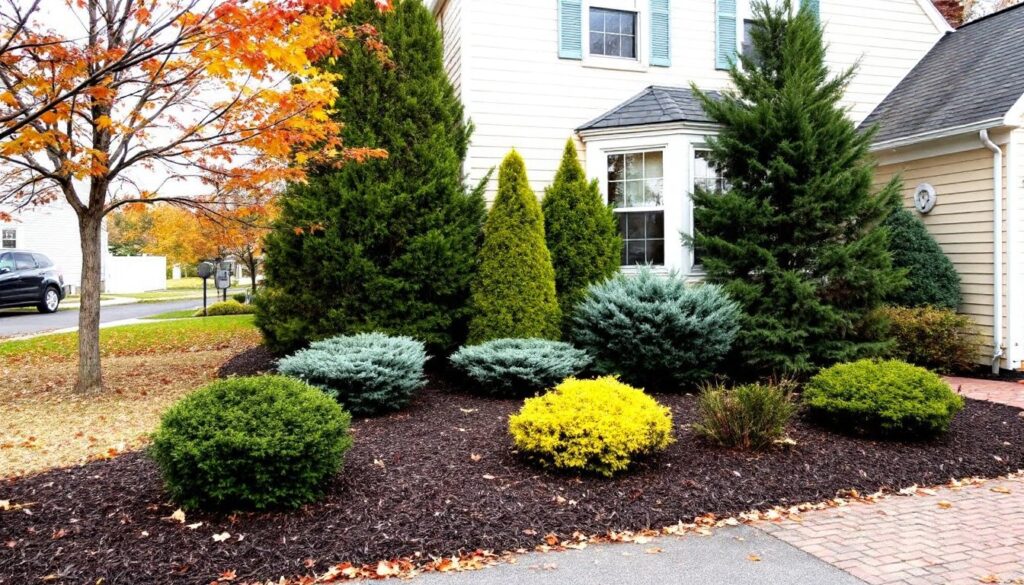
A successful evergreen front yard isn’t a lineup of matching shrubs. It’s a layered composition that works with the home’s architecture and provides visual interest at multiple heights.
Start by identifying focal points: the front door, a picture window, or a corner that needs softening. Place a taller evergreen tree or upright shrub at these spots to anchor the design. Flank entryways with matching specimens for symmetry, or use asymmetry with varying heights for a naturalistic look.
Next, add mass plantings of mid-height shrubs (3–5 feet). Group odd numbers, three or five of the same variety, rather than spacing single plants evenly. This creates cohesion and reduces the “specimen collection” look that screams amateur.
Use groundcover evergreens like creeping juniper or wintercreeper (Euonymus fortunei) to fill gaps and suppress weeds. They tie plantings together and reduce mulch needs over time.
Consider screening needs. If there’s an AC condenser, meter, or downspout to hide, position evergreens 3–4 feet away (never directly against equipment) to allow airflow and service access.
Leave space for seasonal color. Evergreens form the backbone, but gaps for spring bulbs, summer annuals, or ornamental grasses keep the planting from feeling static.
Layering for Depth and Visual Interest
Layering means arranging plants in tiers: tall in back, mid-height in the middle, low or groundcover in front. This applies even in narrow beds.
Place the tallest evergreens, small trees or upright shrubs (6–12 feet), toward the house or rear of the bed. They frame the home and provide vertical structure.
Mid-tier shrubs (3–5 feet) go in front of or beside taller specimens. Mix textures: combine fine-needled junipers with broadleaf boxwood or rounded inkberry for contrast.
Front-edge plants should stay under 2 feet. Dwarf cultivars, groundcovers, or low ornamental grasses work here. This gradation prevents a wall of green and lets each plant read as an individual layer.
Vary foliage color within the green spectrum. Dark green yews, blue-toned junipers, and chartreuse falsecypress create depth without adding non-evergreen elements.
Don’t plant in straight rows unless the home’s architecture is formal (Colonial, Georgian). Most modern and ranch-style homes look better with staggered, naturalistic groupings.
Planting and Care Tips for Evergreen Success
Evergreens tolerate neglect once established, but they won’t thrive without proper planting and initial care.
Timing: Plant in early fall (September–October) or early spring (March–April). Fall planting gives roots time to establish before summer heat. Avoid planting in frozen ground or during July-August heat.
Soil Prep: Dig a hole 2–3 times the width of the root ball but no deeper. Evergreens planted too deep suffocate. The root flare (where roots spread from the trunk) should sit at or slightly above grade. Amend heavy clay with compost (30% compost to 70% native soil). Don’t add sand, it makes concrete. In sandy soil, add compost to improve water retention.
Spacing: Use mature width, not current size. A boxwood that’s 18 inches wide now but matures at 4 feet needs 4 feet of clearance. Measure from center to center. For hedges, overlap mature widths by 25% for faster fill-in.
Watering: Deep soak at planting, then water twice weekly for the first month. Taper to once weekly through the first year. Evergreens don’t go dormant like deciduous plants: they transpire year-round and need moisture, especially before ground freeze.
Mulching: Apply 2–3 inches of shredded hardwood mulch or pine bark, keeping it 3–4 inches away from trunks and stems. Mulch conserves moisture, moderates soil temperature, and suppresses weeds. Refresh annually.
Fertilizing: Most evergreens don’t need heavy feeding. A spring application of slow-release granular fertilizer (10-10-10 or evergreen-specific formula) is plenty. Overfertilizing causes excessive growth and weak foliage.
Pruning: Prune lightly in late winter or early spring before new growth. Remove dead or damaged branches. Shape as needed, but never remove more than one-third of the plant in a season. Use bypass pruners for small cuts, loppers for branches up to 1.5 inches, and a pruning saw for anything larger.
Winter Protection: Broadleaf evergreens and newly planted conifers benefit from burlap windbreaks in harsh climates. Anti-desiccant sprays reduce winter moisture loss. Water thoroughly before ground freeze.
Pest & Disease: Watch for bagworms on arborvitae and juniper (hand-pick in late spring), spider mites on spruce (spray with horticultural oil), and root rot in poorly drained soil (improve drainage or relocate). Most issues trace back to poor siting or watering.
Conclusion
Evergreens aren’t flashy, but they’re the difference between a front yard that works year-round and one that only looks intentional for a few weeks in May. Choose plants based on mature size, site conditions, and maintenance tolerance. Plant them correctly, give them a solid first year of care, and they’ll anchor the landscape for decades with minimal fuss. The result is a front yard that doesn’t need excuses in winter, or constant work in summer.